What "Natural" Really Means on a Supplement Label - And Why Clean Label Is the Better Question
If you are buying supplements for your family, you have probably seen the same words repeated on every label: natural, clean, pure, GMO-free, no artificial anything. They are designed to make you feel confident in what you are choosing
The truth is, the most reliable signal is not the word "natural."
It is whether the label is clear, specific and free from unnecessary additives.
That is what most parents mean when they say they want a clean product - even if the term "clean label" is not always formally regulated either.
This blog is a straightforward guide to help you tell the difference between clean label that is meaningful and clean label that is marketing.
What "Clean Label" Actually Means
Clean label is not one universal legal definition, but in practice most parents use it to mean the same things: fewer unnecessary additives, transparent ingredient choices, no padding ingredients that do not serve a clear purpose, and a formula designed for daily use rather than something that feels harsh or medicinal.
The cleanest labels are usually the ones that answer your questions quickly. What sweetens it? What flavours it? What preserves it? What colours it? If those answers are easy to find and easy to understand, that is a good sign.
The Real Clean Label Test: Sweeteners, Colours and Preservatives
Sweeteners
Some products rely on artificial sweeteners such as sucralose or acesulfame-K. Some families are comfortable with these, others prefer to avoid them - particularly for products that are taken daily. Clean label does not mean no sweetener. It means the sweetener choice is clear, intentional and consistent with what the brand stands for.
Colours
This is an area where definitions shift over time and across countries. Even "no artificial colours" can be interpreted differently depending on the regulatory framework and how it is enforced in a given market. The label claim can be useful, but it is still worth reading the actual ingredient list.
Preservatives
Some formats genuinely need preservation. Others use preservatives simply out of habit or convention. A clean label approach generally avoids unnecessary preservatives and focuses instead on stability through better formulation decisions from the outset.
Where "Natural" Fits - As One Small Piece
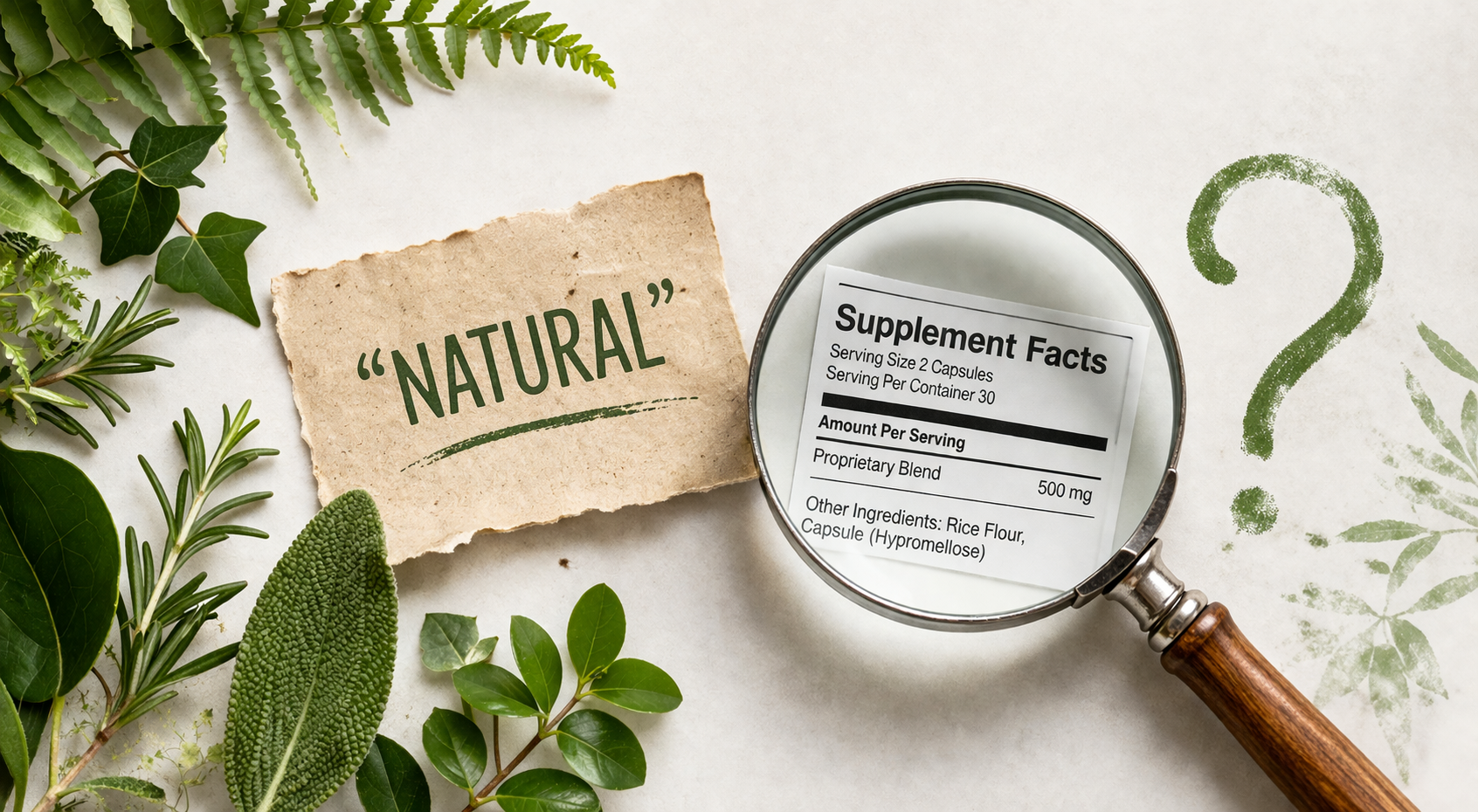
Now to the word that appears on almost everything: natural.
The issue is not that "natural" is a bad thing. It is that many parents reasonably assume it is a tightly regulated guarantee - and in most markets, it is not.
Even large regulators like the US FDA describe "natural" as a longstanding policy position for foods rather than a formal definition created through rulemaking. That creates a practical problem: two products can both carry the word "natural" and still be completely different in their sweeteners, flavours and additives.
Treat "natural" as a clue, not a conclusion. Clean label is what you can actually verify.
A simple way to think about ingredients:
Source-derived natural ingredients are extracted from something in nature - citrus, herbs, minerals and so on. Nature-identical ingredients are manufactured to be chemically the same as what occurs in nature, but produced through a controlled process. Neither is automatically better or worse. What matters most is safety, quality, dose and transparency.
"Natural Flavours" Can Still Be Vague
Flavour wording is one of the biggest sources of confusion for parents reading supplement labels.
In the EU, flavourings are defined and regulated under specific frameworks including Regulation (EC) No 1334/2008. In South Africa, the draft labelling regulations (R.3337) indicate that flavourings are listed simply as "flavouring" in the ingredient list without further descriptors - which limits how much detail actually appears on the pack.
In practice, the phrase "natural flavours" can still cover complex blends, processing aids and carriers, and a flavour that tastes like something without necessarily being made primarily from that ingredient.
If flavour transparency matters to your family, the most useful thing to look for is a brand that explains its flavour and sweetener philosophy clearly - not one that simply uses the word "natural" as a reassurance.
GMO-Free: Sometimes Meaningful, Sometimes Badge Marketing
GMO-free can be genuinely important to some families. But it can also function as a general health halo - particularly when it is applied to products that are primarily vitamins, minerals and amino acids, none of which are genetically modified in the way crops are.
It is not a red flag. Just ask yourself: does this badge actually change what is inside the product? If the answer is not immediately clear, it is probably more of a branding signal than a meaningful differentiator.
A Practical Checklist for Parents
Next time you are choosing a supplement for your child, run through these five questions:
1: What is the sweetener? Is it clearly stated and something your family is comfortable with for daily use?
2: What is the flavour wording? Is it specific, or does it just say "natural flavours" with no further context?
3: Are there unnecessary colours or preservatives? For a daily product, simpler is usually better.
4: Do the claims sound measured? Supportive language is a good sign. Miracle language - "fixes anxiety," "cures ADHD" - is a red flag.
5: Does the brand explain why they made the choices they did? Transparency in formulation is one of the clearest signals of a brand that takes its products seriously.
What Clean Label Means to Us at Bioteen
At Bioteen, clean label is practical rather than performative.
For us it means avoiding artificial sweeteners like sucralose and acesulfame-K, avoiding unnecessary preservatives wherever possible, using no artificial colours, and building formulas that fit real routines - school days, sport, busy weeks - without unnecessary complexity.
We also aim to be specific about what we use and why, because we believe parents deserve more than a reassuring word on the front of a pack. Clean label should be something you can read, verify and feel confident about - not something you simply have to trust.
If you want one simple principle to take away: trust what you can verify.
"Natural" can be part of the story. But clean label is the more useful lens - because it focuses on what actually shapes daily use: sweeteners, flavours, additives, transparency and the kind of claims a brand is willing to stand behind.
FAQ's
What does "natural" mean on a supplement label? In most markets, "natural" is not a single tightly regulated legal definition. In the US, for example, the FDA has a longstanding policy position on "natural" for foods but has not created a formal definition through rulemaking. Two products can both carry the word "natural" and still differ significantly in their sweeteners, flavours and additives. Treat it as a starting point for questions, not as proof.
What does "clean label" mean for supplements? Clean label generally means fewer unnecessary additives, transparent ingredient choices, no padding ingredients without a clear purpose, and formulas designed for daily use. The most useful clean label products are those where the sweetener, flavour and preservative choices are clearly explained - not just implied by a word on the front of the pack.
What is the difference between natural and nature-identical ingredients? Natural ingredients are extracted or derived from something found in nature. Nature-identical ingredients are manufactured to be chemically the same as their natural counterpart but produced through a controlled process. Neither is automatically safer or better - what matters most is safety, quality, dose and transparency.
Are artificial sweeteners in supplements safe for teenagers? Common artificial sweeteners such as sucralose and acesulfame-K are considered safe within regulatory limits in most markets. However, many parents prefer to avoid them for daily-use products, particularly for children and teenagers. A clean label approach involves being transparent about which sweeteners are used and why.
What does "GMO-free" actually mean on a supplement? GMO-free indicates that ingredients have not been genetically modified. For some families this is important. However, in products that are primarily vitamins, minerals and amino acids, the term may function more as a branding signal than a meaningful differentiator, since these ingredient types are not genetically modified in the way crops are.
What should I look for when buying supplements for my teenager? Focus on five things: whether the sweetener is clearly stated and appropriate for daily use, whether the flavour wording is specific or vague, whether there are unnecessary colours or preservatives, whether the health claims sound measured and evidence-based, and whether the brand explains its formulation choices transparently.
What does Bioteen mean by clean label? Bioteen's clean label approach means no artificial sweeteners such as sucralose or acesulfame-K, no unnecessary preservatives, no artificial colours, and formulas built around transparent and purposeful ingredient choices. The goal is a product parents can read, verify and feel confident about - not one that relies on reassuring words alone.
References
- U.S. Food and Drug Administration. Use of the Term "Natural" on Food Labeling (policy position; not formal rulemaking definition).
- U.S. Federal Register. Use of the Term "Natural" in the Labeling of Human Food Products (Request for Information).
- European Commission. Flavourings - EU rules (Regulation (EC) No 1334/2008 framework).
- South Africa Department of Health. Draft labelling regulations R.3337 (flavouring labelled as "flavouring" without further descriptors).
- U.S. Federal Trade Commission. Health Products Compliance Guidance (truthful, evidence-based advertising).